
Recent post
Bangladesh Lubricant Market Update: Why Prices and Supply Are Changing
Market Note by Ahmed M. Quiyum
Director, Pacific Oil Company Ltd. | SINO Bangladesh
The lubricant market in Bangladesh is passing through a sensitive period.
Over the last few months, many dealers, retailers, mechanics and customers have been asking the same question: why are lubricant prices changing so often, and why is supply not as smooth as before?
From what we are seeing in the market, the answer is not only inside Bangladesh. A big part of the pressure is coming from the international supply chain.
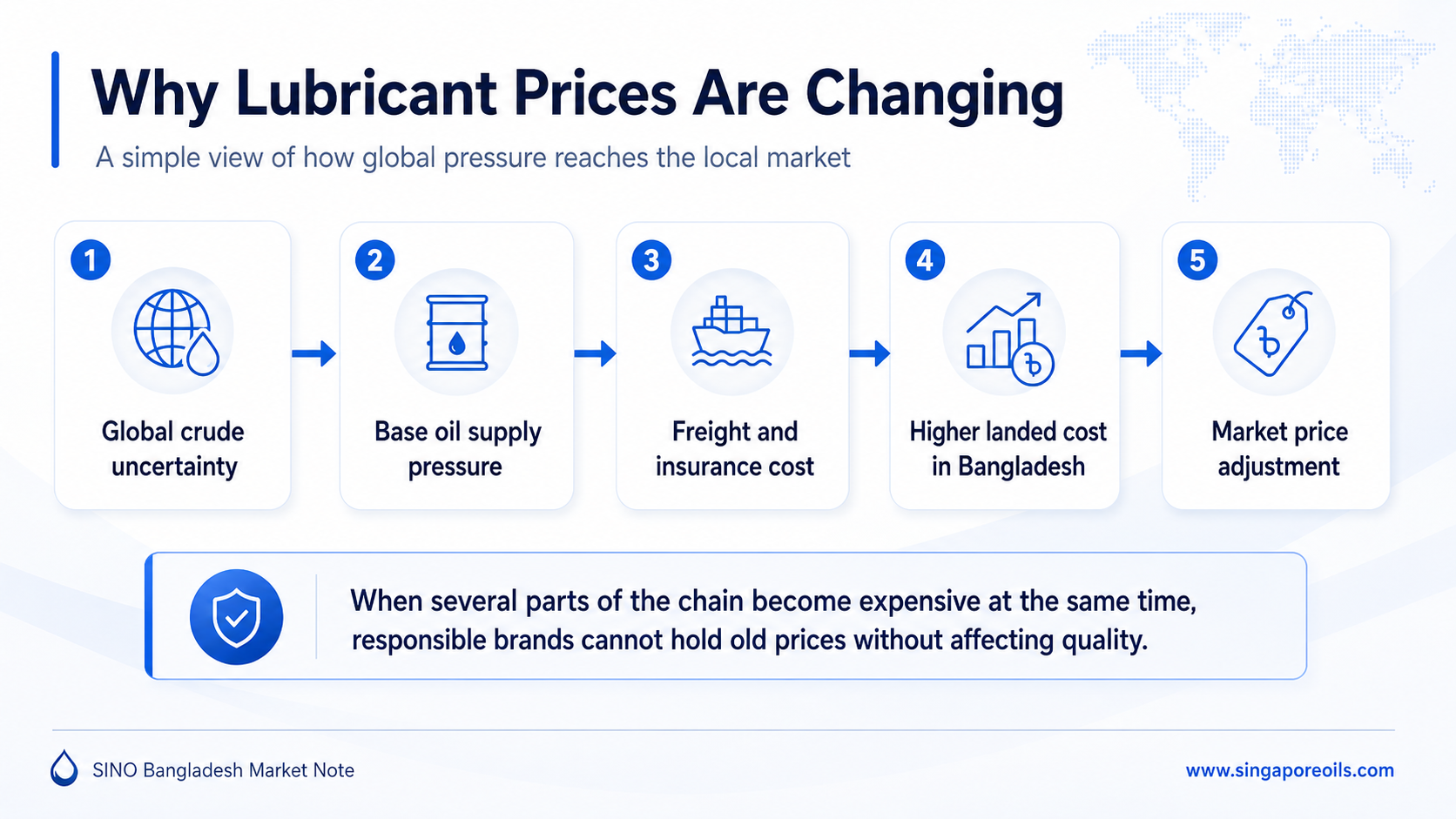
Bangladesh depends heavily on imported base oil, additives and other lubricant-related raw materials. So when global crude oil movement becomes unstable, freight cost increases, or base oil suppliers become cautious, the impact eventually reaches our local market.
That is exactly what the market is experiencing now.
Base oil is the main pressure point
For any lubricant manufacturer or importer, base oil is the heart of the product. If base oil becomes expensive or difficult to source, the final lubricant market cannot remain unaffected.
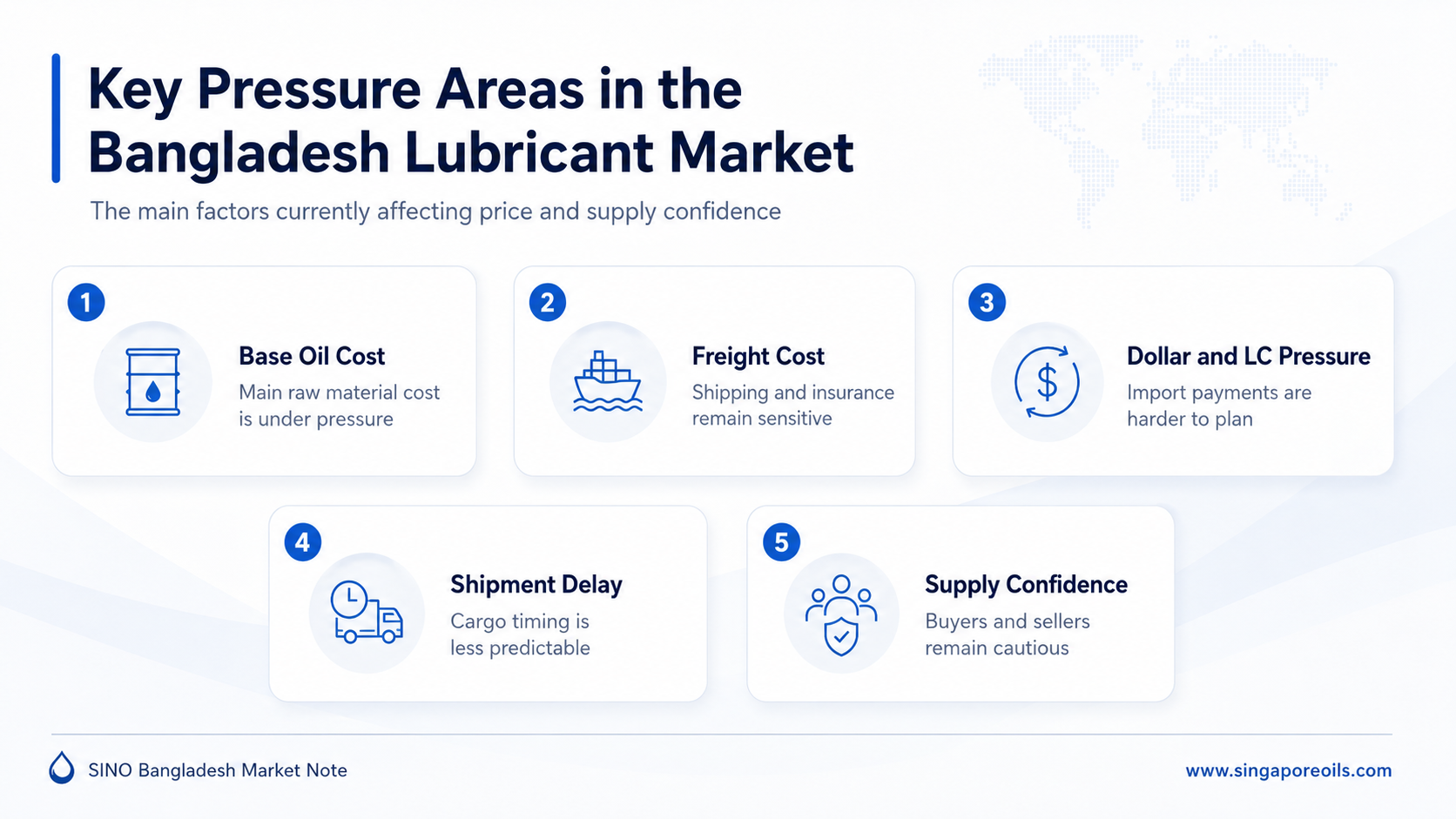
Right now, the market is facing pressure from several sides:
-
Higher base oil cost
-
Unstable freight movement
-
Shorter quotation validity from suppliers
-
Shipment delays
-
Dollar and LC pressure
-
Cautious buying from distributors and retailers
This is why the market feels unstable. It is not only a price issue. It is also a supply confidence issue.
Global tension is affecting local pricing
The recent tension around the Middle East and the Strait of Hormuz has created concern across the oil and shipping market. The Strait of Hormuz remains one of the most important energy routes in the world, and any uncertainty there affects crude oil, freight, insurance and shipping confidence.
Recent reports show that oil prices have been reacting sharply to news about military tension, shipping disruption and possible negotiations. At the same time, there have also been positive signs, including discussion of a possible framework that could restore commercial shipping through Hormuz if an agreement is finalized.
For Bangladesh, this matters because we do not operate in isolation. When international supply becomes uncertain, import-dependent markets like ours feel the pressure quickly.
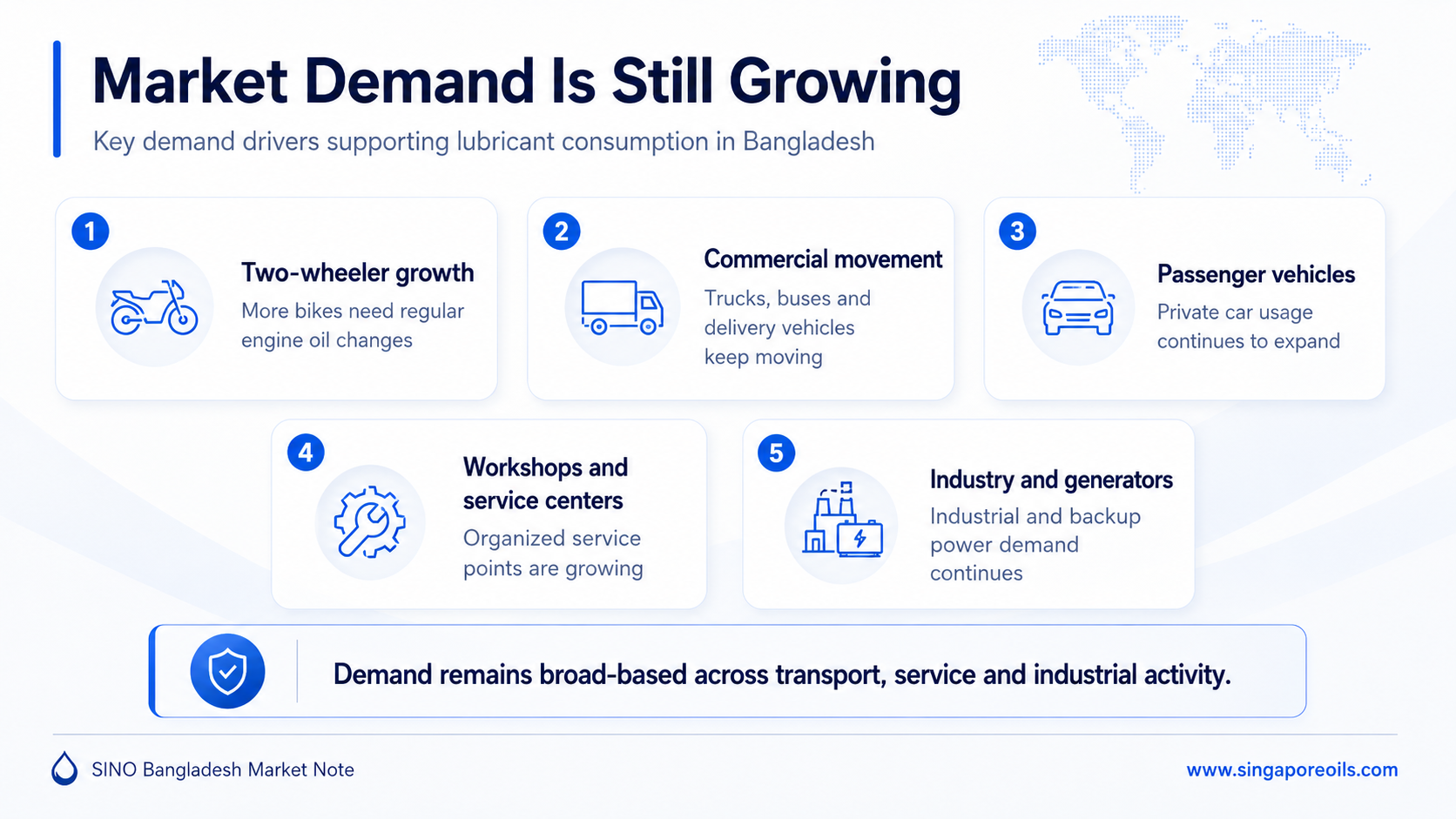
Demand in Bangladesh is still strong
The positive side is that Bangladesh lubricant demand is not weak.
Motorcycles, passenger cars, commercial vehicles, generators, workshops, industrial users and transport businesses all continue to need reliable lubricants every day.
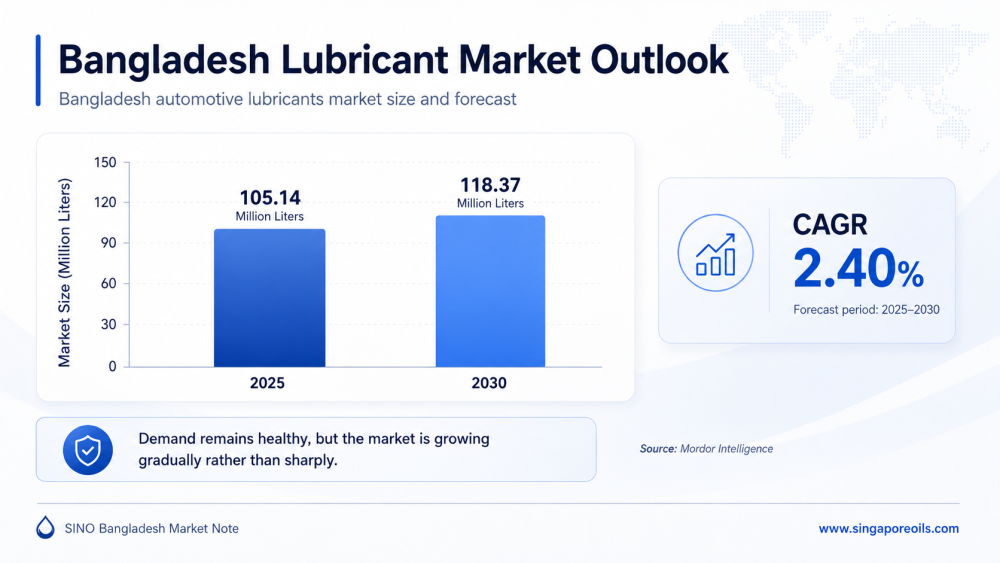
According to Mordor Intelligence, the Bangladesh automotive lubricants market is estimated at 105.14 million liters in 2025 and is expected to reach 118.37 million liters by 2030. The wider Bangladesh lubricants market was valued at 218.73 million liters in 2025 and is forecast to grow further by 2031.
So the market is not falling.
The demand is there. The growth is there. But the cost structure behind the market is changing.
Why customers are feeling the change
A bottle of lubricant on a shop shelf may look simple. But behind that bottle, there is a full chain:
-
Base oil
-
Additives
-
Packaging
-
Shipping
-
Customs
-
Banking
-
Blending
-
Quality control
-
Distribution
-
Retail support
When one or two parts of this chain become expensive, the final product price becomes difficult to hold. When many parts become expensive at the same time, the whole market feels the pressure.
That is why responsible brands cannot always hold old prices without affecting quality.
The market is becoming more aware
One good thing we are seeing is that customers and retailers are becoming more careful.
Before, many buyers looked only at price. Now more people are asking better questions:
-
Is the product genuine?
-
Is the grade correct?
-
Will it protect the engine?
-
Is the brand reliable?
-
Is the supply consistent?
-
Will this product protect the shop owner’s reputation?
This is a healthy change for the Bangladesh lubricant market.
A strong lubricant market cannot be built only on gifts, discounts and short-term pushing. It has to be built on product quality, correct application, reliable supply and long-term trust.
What we expect in the coming months
The next few months may remain sensitive. Base oil availability can improve gradually, but the market may not become normal overnight.
Asia base oil reports are showing mixed pricing and cautious market activity, which means the market is moving, but not yet fully comfortable.
If international shipping becomes smoother and base oil supply improves, we may see better stability later this year. But until then, buyers, dealers and retailers should expect some level of price movement.
The best approach now is to plan carefully, avoid panic buying, and work with reliable suppliers who can maintain product consistency.
Our view from SINO
At SINO Bangladesh, we believe the market needs honest communication.
We are not sharing this update only to talk about our own brand. We believe dealers, retailers, mechanics, fleet owners and customers should understand what is happening behind the market.
Bangladesh’s lubricant market has strong potential. But the next stage of growth should come from better awareness, better product selection, and stronger trust between brands, sellers and users.
We will continue sharing market updates from time to time so our partners and customers can stay informed.
SINO Bangladesh
Singapore-origin lubricant solutions for Bangladesh roads
www.singaporeoils.com